

What is AI Infrastructure?
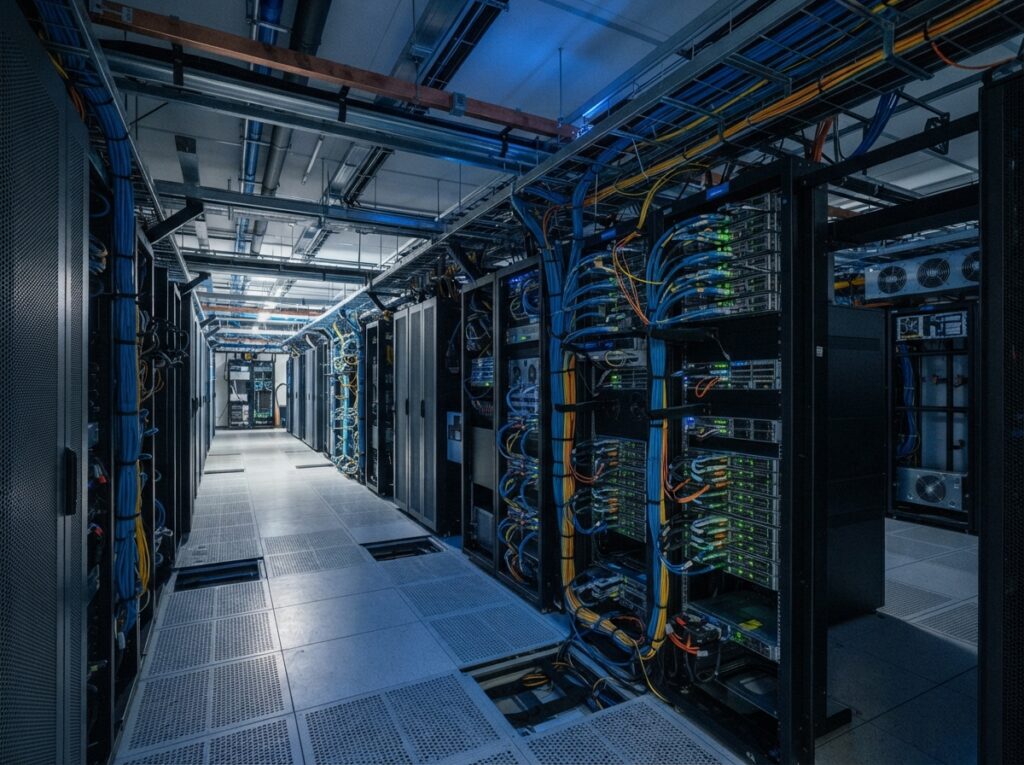
AI infrastructure is the combination of computing resources, storage, networking, software, and management tools required to develop, train, deploy, and operate artificial intelligence (AI) applications. It provides the high-performance environment needed to support machine learning, generative AI, computer vision, and advanced analytics.
Artificial intelligence is rapidly transforming how organizations operate. Businesses are using AI to automate processes, improve customer experiences, detect fraud, analyze large datasets, optimize operations, and make faster decisions.
However, AI applications require significantly more computing power than traditional business software. Training machine learning models, processing large datasets, and running generative AI applications demand specialized infrastructure that can deliver high-performance computing, fast storage, and reliable networking.
This is where AI infrastructure becomes essential.
Rather than replacing traditional IT infrastructure, AI infrastructure extends it by providing the resources required to support modern AI workloads alongside existing business applications.
Organizations beginning their AI journey often start by strengthening their Enterprise Cloud Solutions, creating a scalable foundation that can support both traditional workloads and future AI initiatives.
Core Components of AI Infrastructure
High-Performance Compute
AI applications rely on powerful computing resources capable of processing millions of calculations simultaneously.
Modern AI platforms typically combine CPUs with GPU-enabled environments to accelerate model training and inference.
Organizations deploying AI workloads often use Elastic Cloud Servers (ECS) with GPU capabilities to support demanding computational requirements.
GPU Infrastructure
Graphics Processing Units (GPUs) are designed to perform thousands of calculations in parallel, making them ideal for AI, deep learning, and computer vision applications.
Compared to CPUs alone, GPUs can dramatically reduce the time required to train machine learning models.
High-Speed Storage
AI workloads continuously process large datasets.
Fast, scalable storage enables rapid access to training data, model checkpoints, and enterprise information while supporting growing AI environments.
Networking
AI clusters require high-speed communication between servers, storage, and applications.
Secure networking solutions such as Virtual Private Cloud (VPC) help organizations isolate workloads while maintaining reliable connectivity between AI resources.
Data Management
High-quality data is the foundation of successful AI.
Organizations require infrastructure capable of storing, organizing, securing, and processing structured and unstructured information efficiently.
Why AI Infrastructure Matters
Faster Model Training
Specialized infrastructure significantly reduces the time required to train machine learning models, allowing organizations to develop and deploy AI solutions more efficiently.
Scalable AI Workloads
As AI adoption grows, infrastructure must support increasing data volumes and computational requirements without requiring complete system redesign.
Better Performance
Optimized compute, storage, and networking improve AI model performance while reducing processing delays.
Enterprise Security
AI environments often process sensitive business information.
Enterprise-grade infrastructure provides secure networking, access controls, monitoring, and workload isolation to protect AI applications and data.
Future Readiness
Organizations investing in AI infrastructure today are better positioned to adopt emerging technologies such as generative AI, intelligent automation, predictive analytics, and advanced decision support.
Common AI Infrastructure Use Cases
AI infrastructure supports a wide range of enterprise applications.
Machine Learning
Develop and train predictive models using structured business data.
Generative AI
Support large language models, intelligent assistants, and content generation applications.
Computer Vision
Analyze images and video for quality inspection, security monitoring, healthcare diagnostics, and industrial automation.
Fraud Detection
Process large transaction datasets to identify unusual patterns and reduce financial risk.
Predictive Analytics
Use historical data to forecast demand, optimize operations, and improve business planning.
Intelligent Automation
Combine AI with business workflows to automate repetitive tasks and improve operational efficiency.
AI Infrastructure vs Traditional Infrastructure
Traditional Infrastructure | AI Infrastructure |
Optimized for business applications | Optimized for AI and data-intensive workloads |
Primarily CPU-based | Combines CPU and GPU computing |
Standard storage performance | High-performance storage for large datasets |
Supports transactional systems | Supports model training and inference |
Designed for predictable workloads | Built for highly parallel processing |
Choosing the Right AI Infrastructure
Organizations planning AI initiatives should evaluate infrastructure based on:
- GPU availability
- Compute scalability
- High-performance storage
- Secure networking
- Data management capabilities
- Enterprise security
- Integration with existing IT environments
Businesses with requirements around infrastructure location or operational control may also consider a Sovereign Cloud strategy when designing AI environments.
Frequently Asked Questions
Answers to common questions about AI infrastructure.
AI infrastructure is the combination of compute, storage, networking, software, and management technologies that support artificial intelligence applications.
GPUs perform parallel calculations much faster than traditional CPUs, making them highly effective for training and running AI models.
No. Organizations of all sizes can benefit from AI-ready infrastructure depending on their workloads and business objectives.
Yes. Modern AI infrastructure is designed to support large language models, generative AI applications, and advanced analytics.
Not necessarily. AI can run on cloud, on-premises, or hybrid environments depending on organizational requirements.
AI infrastructure is optimized for high-performance computing, GPU acceleration, and processing large datasets rather than only supporting traditional business applications.
Yes. Modern AI platforms are designed to expand compute, storage, and networking resources as workloads increase.
Banking, healthcare, manufacturing, retail, logistics, telecommunications, government, and many other industries use AI infrastructure to improve efficiency and decision-making.
Key Takeaways
- AI infrastructure provides the computing foundation required for machine learning, generative AI, analytics, and intelligent automation.
- GPUs play a critical role in accelerating AI workloads.
- AI infrastructure extends traditional enterprise IT rather than replacing it.
- Secure, scalable, and high-performance infrastructure enables organizations to adopt AI with confidence.
- Investing in AI-ready infrastructure prepares businesses for future innovation and digital transformation.
Who powers the Indus Cloud ecosystem












Ready to Modernize Your Enterprise Infrastructure?
Whether you’re planning a cloud migration, expanding digital services, or preparing your organization for AI-driven innovation, Indus Cloud provides enterprise-grade cloud infrastructure designed to support your business today and into the future.